- Serves
- 8 as a side
- Hands-on
- 20 min
- Start to finish
- 1 hr 35 min, plus chilling; about 15 min to reheat
- Difficulty
- Easy
- Make ahead
- Make up to 2 days ahead and refrigerate in a covered microwave-safe bowl; reheat in the microwave at Carson's. Do not freeze.
- Vegetarian
- Yes
What you are making
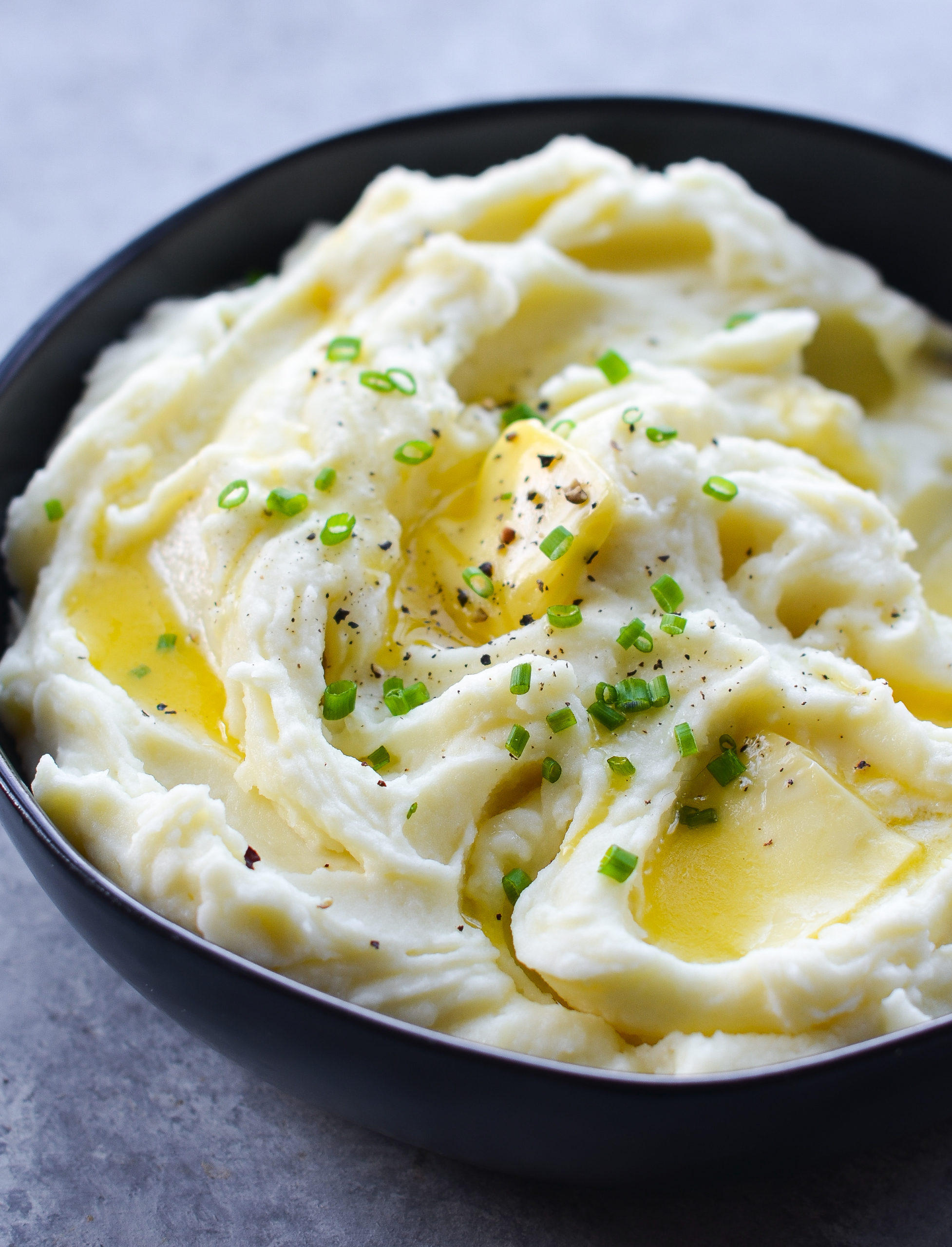
Smooth, rich mashed potatoes: soft enough to spread, with no lumps, tasting of potato, butter and cream. In the US they are a must on the Thanksgiving plate, usually with gravy poured into a dip in the top. This version is built to be made ahead: you make it at home up to two days before, carry it cold in the bowl you will reheat it in, and reheat it in Carson's microwave, so it needs none of his oven or stove.
What makes this version good
- The potatoes are baked whole instead of boiled. Baked russet flesh is dry and fluffy, so it can absorb a lot of cream and butter without going gluey. That extra fat is what keeps the mash creamy after two days in the fridge and a reheat.
- The hot cream and butter are folded in by hand. Beating potatoes too hard makes them sticky and gluey; folding with a spatula avoids that.
- The potatoes are mashed while still hot, which is when they go smooth. Cold cooked potato goes lumpy.
- Two tablespoons of butter are kept back to melt over the top after reheating, so it looks and tastes freshly made.
Shopping list
This is for one batch (8 servings). For a bigger crowd, make two full batches in two separate bowls and reheat them one after the other; the reheating time below is for one batch.
Produce
- 3 1/2 lb russet potatoes. Russets are the large, brown, rough-skinned potatoes sold loose or in 5 lb bags, sometimes labelled "baking potatoes". Do not swap in red or yellow potatoes; the recipe depends on russets' dry, floury flesh. Pick potatoes of similar size so they bake in the same time. If you buy a 5 lb bag, weigh out 3 1/2 lb (most supermarkets have a produce scale).
- 1 small bunch or package of fresh chives, for the top. Chives look like thin, hollow green grass and taste mildly of onion; they are with the fresh herbs.
Dairy and eggs
- 2 cups heavy cream (one 1-pint carton). Do not use milk or half-and-half; the recipe needs the fat to survive the make-ahead.
- 1/2 cup (1 stick) unsalted butter
Spices and seasonings
- 1 1/2 tsp salt (you may have this)
Other
- Microwave-safe plastic wrap
Equipment
- Oven, and a fork for pricking the potatoes
- Stand mixer with the paddle attachment. If you do not have one: a hand-held electric mixer, or a potato ricer or food mill and a wooden spoon. A plain potato masher works too, but expect a few small lumps.
- Small saucepan for the cream
- Large rubber spatula
- Oven mitts or a folded kitchen towel to hold the hot potatoes, and a spoon for scooping
- A large microwave-safe bowl (glass or ceramic), big enough that the potatoes fill it no more than about two-thirds, so the plastic wrap does not touch them. Check that it fits in a normal microwave and can turn on the turntable; you will reheat it in this same bowl at Carson's.
Game plan
- Up to 2 days ahead: make the mash (about 1 hr 35 min, mostly baking time). Refrigerate it covered in the microwave-safe bowl.
- On the day: carry the cold bowl to Carson's, with the reserved 2 Tbsp butter and the chives packed separately.
- At Carson's, about 20 min before eating: reheat in the microwave for about 14 minutes, stirring halfway.
Steps
- Heat the oven. Put a rack in the middle of the oven and heat it to 450°F.
- Prick and bake the potatoes. Scrub the potatoes and dry them. Prick each one a few times all over with a fork so steam can escape. Put them straight onto the oven rack (or on a wire rack set in a rimmed baking sheet). Bake until very soft, 50 to 60 minutes, depending on size. They are done when a knife slides into the center with no resistance and the potato feels soft and gives when you squeeze it with an oven mitt. If in doubt, bake them longer: overbaked is fine, underbaked will not mash smoothly.
- Heat the cream and butter. Near the end of the baking time, cut the stick of butter into tablespoons. Set aside 2 Tbsp in the fridge for serving. Put the 2 cups cream and the other 6 Tbsp butter in the small saucepan over medium heat and bring it to a simmer: small bubbles around the edge and the butter melted. Turn the heat to low to keep it hot.
- Scoop the flesh while hot. Take the potatoes out. Working quickly while they are still hot, cut each one in half lengthwise. Hold each half with an oven mitt or folded towel and scoop the white flesh into the mixer bowl. Leave behind the thin, slightly tougher layer right against the skin. Throw away the skins.
- Mash until completely smooth. Break up the flesh in the bowl with a masher, fork or spatula. Fit the paddle and beat on low speed for 1 to 2 minutes, stopping to scrape the sides and bottom, until there are no lumps at all. Do this while the potatoes are hot; once they cool, lumps will not beat out.
- Fold in the hot cream by hand. Take the bowl off the mixer. Pour in the hot cream and butter a little at a time, folding it in with the large spatula: scoop from the bottom and turn it over the top, rather than stirring fast or beating. It will look soupy at first and take a few minutes to absorb. Keep folding until it is smooth, creamy and glossy, like thick frosting.
- Season. Stir in the 1 1/2 tsp salt, then taste. It should taste clearly seasoned, not flat; add a pinch more salt if needed.
- Cover and chill. Spoon the potatoes into the large microwave-safe bowl and smooth the top. Cover tightly with microwave-safe plastic wrap, stretched across the rim so it does not touch the potatoes. Let it cool, then refrigerate for up to 2 days. Do not freeze.
- Reheat (at Carson's). Poke about 10 holes in the plastic wrap with the tip of a knife. Microwave at 75 percent power (on most microwaves, press "Power" and choose level 7 or 8) for about 14 minutes total, stopping halfway through to take it out, peel back the wrap and stir well, then cover again and continue. It is ready when it is steaming and hot right in the center after a stir. Microwaves vary, so if the middle is still cool, give it more time in 1 to 2 minute bursts and stir again.
- Finish. Taste and add salt if needed. Spoon into a serving dish (or serve from the bowl), put the reserved 2 Tbsp butter on top to melt, and scatter over the chives, snipped into short pieces with scissors.
Getting it to Carson's
Make it ahead and carry it cold, covered, in the microwave-safe bowl, in a cooler bag or with an ice pack if the trip is long. Put it in Carson's fridge when you arrive. It needs his microwave only, for about 14 minutes at 75 percent power, stirring halfway (step 9). Do not reheat it at home and carry it hot: it firms up as it cools and would need reheating again anyway. If the microwave is not available, the source's oven method is 350°F for 30 to 40 minutes in an oven-safe dish covered tightly with foil, stirring halfway, but avoid this, because oven space on the day is the thing in shortest supply. Bring the 2 Tbsp butter, the chives and a pair of scissors with you.
If something goes wrong
- It is lumpy. The potatoes were underbaked or had cooled before mashing. Bake until truly soft and mash immediately. A few small lumps are not a disaster once there is gravy on them.
- It is gluey or sticky. It was beaten too hard after the cream went in. Fold by hand only. Gluey mash cannot be fixed, but it still tastes good.
- It is stiff after reheating. This mash firms up when cold. Stir it well once it is hot; it loosens as it heats.
- The edges are hot but the center is cold. It was not stirred halfway, or the microwave is weak. Stir well and heat in short bursts until the center is hot.
- It tastes flat. Add salt a pinch at a time and stir; potatoes need more salt than people expect.
Changes from the original
- None. Quantities, temperatures, times and the reheating method are as published. We added the note on making two separate batches for a bigger crowd, so the source's 14-minute reheating time still applies to each bowl.